FL HVAC Team ·
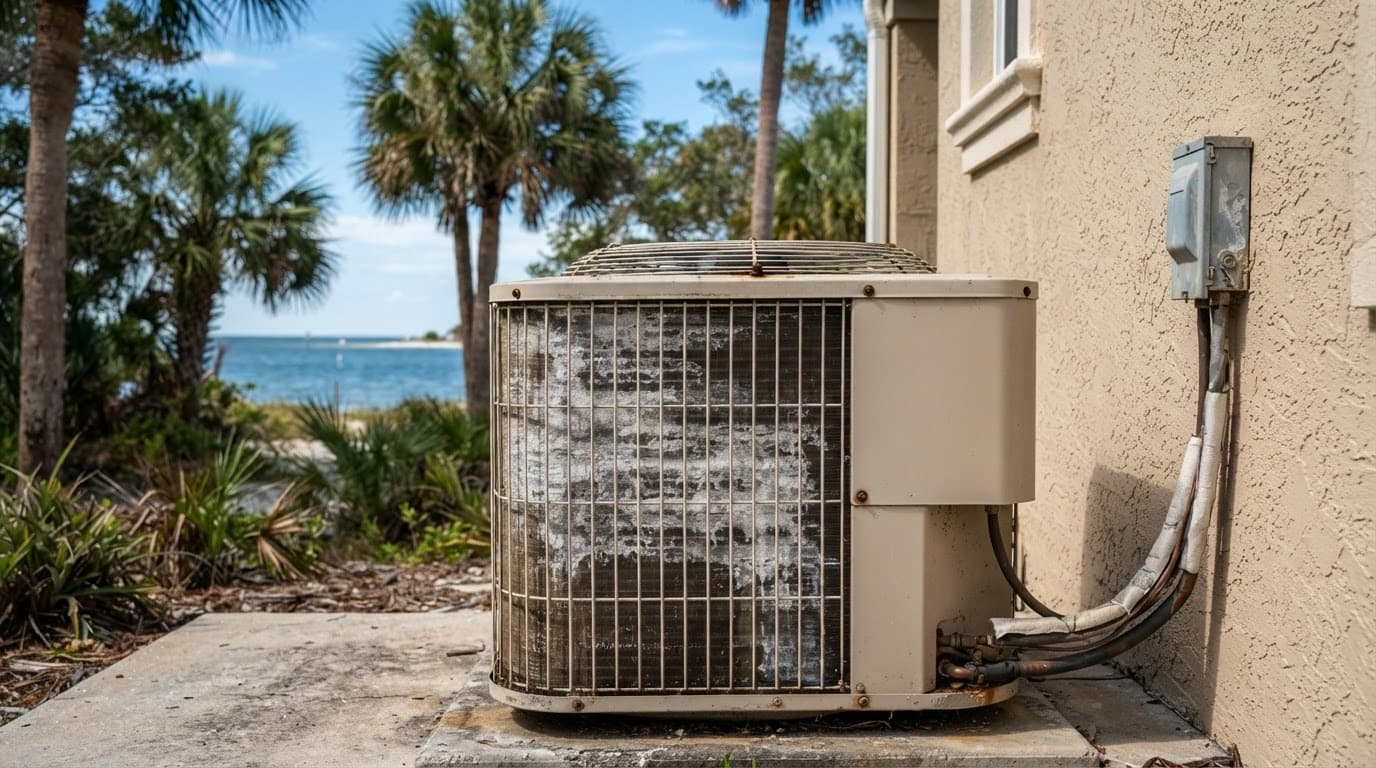
If your AC unit sits within a mile or two of the Gulf, it is fighting a battle every single day that a system in Brandon or Riverview never has to think about. That battle is saltwater corrosion, and it is quietly the biggest reason coastal HVAC systems in Pinellas County fail years earlier than the manufacturer's rated lifespan.
Homeowners in St. Petersburg, Largo, Seminole, and Dunedin usually notice the symptoms before they ever hear the word "corrosion." The outdoor unit starts running longer than it used to. Cooling feels weaker on the hottest afternoons. A technician shows up for what seems like a simple repair and finds coil fins flaking away like rust on an old bike frame. None of that is bad luck. It is what salt air does to metal, on a schedule that is faster and more predictable than most homeowners realize.
FL HVAC Team sees this pattern constantly across Pinellas County, and it shapes almost everything about how a coastal system should be installed, maintained, and eventually replaced. Understanding why it happens, and what actually slows it down, can be the difference between a unit that lasts 15 years and one that needs major repairs by year eight.
In this article, you will learn about:
- Why salt air is uniquely destructive to outdoor HVAC equipment
- How far inland saltwater corrosion actually reaches
- The warning signs that corrosion is already damaging your system
- What homeowners and technicians can do to slow the damage down
Keep reading to find out whether your unit's location is quietly working against it, and what you can do before the damage becomes expensive.
What makes salt air so much worse for HVAC equipment than ordinary humidity
Every AC condenser in Florida deals with humidity. Only a fraction of them deal with what Pinellas County units deal with, which is a constant, invisible coating of sodium chloride settling onto every exposed metal surface outside the home. Understanding the mechanism behind that damage explains why coastal units age so differently from inland ones.
The chemistry behind a slow, invisible attack
Salt is hygroscopic, meaning it actively pulls moisture out of the air and holds it against whatever surface it lands on. That creates a thin, persistent film of saltwater on the aluminum fins and copper tubing of a condenser coil, even on days when it never rains. Ordinary humidity comes and goes with the weather. A salt film just sits there, working.
That film sets off an electrochemical reaction between the salt, the moisture, and the metal itself. It is the same basic process that turns a beach bike rusty in a single season, except here it is happening to the components that move refrigerant, protect electrical connections, and keep a compressor running smoothly.
The three components that take the brunt of it
Three parts of a standard outdoor unit absorb most of the damage:
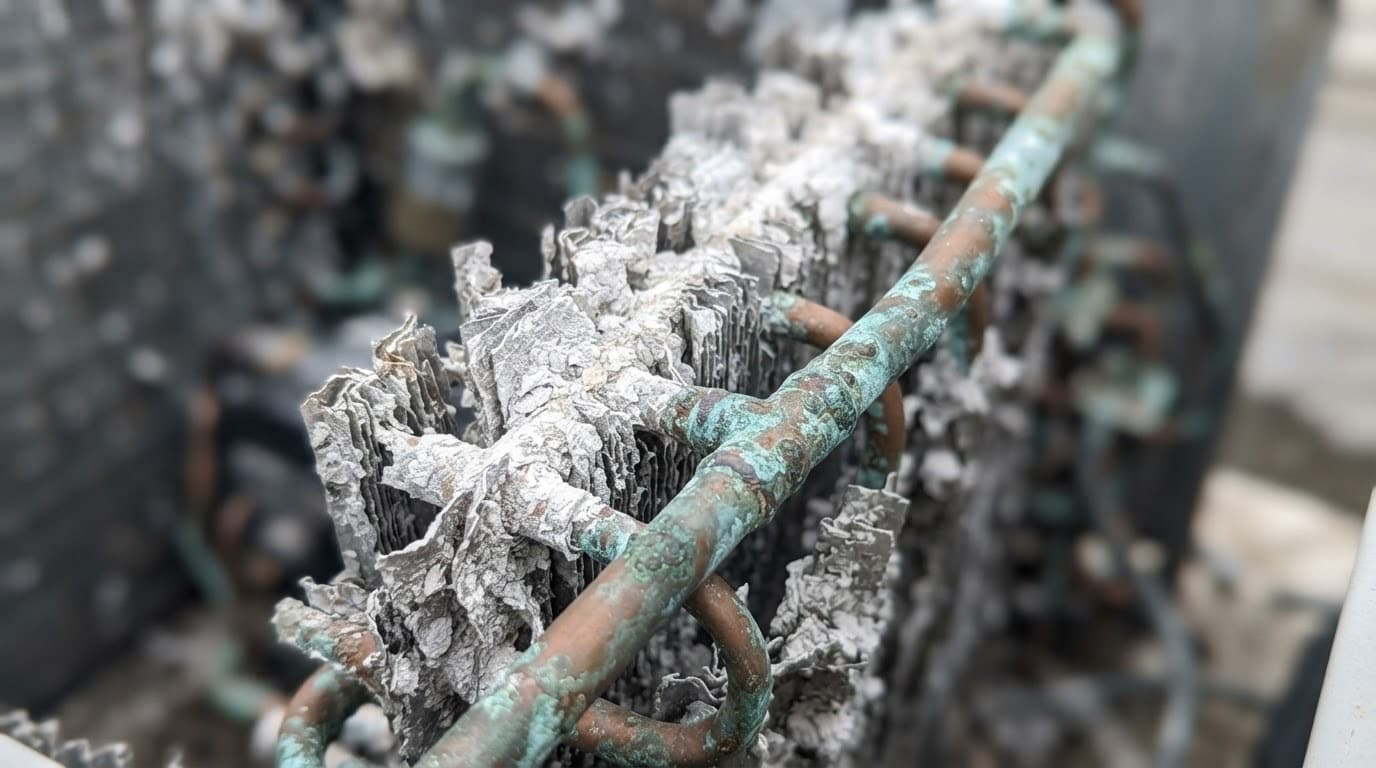
- Aluminum coil fins, which corrode first and fastest, often developing a white, flaky residue as the metal breaks down
- Copper refrigerant lines, which corrode more slowly but can eventually develop pinhole leaks where salt exposure is heaviest
- Electrical contacts and wiring connections, where corrosion causes intermittent failures long before anything looks visibly damaged
A unit running in a landlocked Florida county might see meaningful coil corrosion after ten or twelve years. A unit sitting three blocks from Boca Ciega Bay can show the same wear in three or four.
Why coil damage strains the whole system
Every one of those components plays a role in how efficiently the system runs and how much strain the failing AC compressor takes on. When the fins deteriorate, the coil cannot shed heat properly, which forces the whole system to work harder for the same amount of cooling. That extra strain shortens the lifespan of everything downstream of it, not just the coil.
A unit compensating for a corroded coil also tends to run longer cycles just to hit the same target temperature, which puts more hours on the compressor and the electrical components over the course of a summer than a healthy system would ever need. Corroded copper lines eventually reach the point where identifying a refrigerant leak becomes part of the diagnosis, since the same pinhole corrosion that weakens the line wall is exactly what lets refrigerant escape.
How far inland the damage actually travels
A common assumption is that saltwater corrosion is only a problem for the handful of homes directly on the water. That is not how salt spray behaves, and it is one of the most underestimated risks for homeowners a mile or two back from the coastline.
What the science says about salt spray distance
Salt spray corrosion is worst right at the shoreline, but the Federal Emergency Management Agency's coastal construction guidance notes that corrosivity decreases only gradually over longer distances, with real effects reaching well inland from the immediate coast. Wind carries aerosolized salt particles far beyond the beach itself, and prevailing onshore winds push that salt-laden air steadily further in.
That matters directly for Pinellas County, since so much of the county sits on a narrow peninsula with water on more than one side. Local weather station data puts average relative humidity in Pinellas at 78 to 83 percent across most of the year, which is high enough to keep that salt film against exposed metal for long stretches at a time instead of drying off between exposures.
Why Pinellas homes face exposure from multiple directions
Homes in St. Petersburg, Dunedin, and the barrier-adjacent parts of Largo are exposed on multiple fronts, not just one, which is part of why local units tend to show corrosion damage earlier than equivalent systems even a modest distance inland. A few factors determine how bad the exposure gets at any given address:
- Distance from open water, both Gulf-side and bay-side
- Prevailing wind direction relative to the home's outdoor unit
- Elevation and how sheltered the unit is from direct wind
- Whether the unit faces the water or is shielded by the structure of the home
Homeowners often assume that being a few streets back from the beach solves the problem. In practice, distance helps, but it does not eliminate the exposure the way most people expect.
Why the whole service area falls inside the risk zone
A unit on the water-facing side of a home in Seminole or Apollo Beach can take on meaningful salt exposure even without a direct beachfront view. This is exactly why FL HVAC Team treats coastal corrosion protection as standard practice across its entire Pinellas footprint, not just for homes sitting directly on the shoreline. The whole service area falls inside the zone where salt exposure genuinely matters, and it is the same reason hurricane season preparation for outdoor equipment gets treated so seriously here, since storm winds push months of ordinary salt exposure onto a unit in a single afternoon.
The warning signs a system is already losing the fight
Corrosion damage rarely announces itself all at once. It shows up as a string of small symptoms that homeowners tend to explain away individually, right up until the day the system stops cooling altogether.
The visible signs on the outdoor unit
The most visible sign is physical: a white, chalky residue or visible flaking on the aluminum fins of the outdoor unit. That residue is aluminum oxide, the byproduct of the metal actively breaking down. Once it is visible, the coil has already lost some of its ability to transfer heat efficiently.
A technician doing a coastal inspection will usually check the fins first for exactly this reason, since it is the earliest and most reliable physical indicator of how far corrosion has already progressed. Homeowners sometimes chase a temperature reading error on the thermostat display without realizing the real source is a corroded sensor connection at the outdoor unit rather than the thermostat itself.
The performance symptoms homeowners notice first
Performance symptoms tend to show up before the visible ones do, though homeowners often notice these first without connecting them to corrosion at all:
- Longer cooling cycles than the system used to run, even on comparable days
- Noticeably weaker airflow or cooling power on the hottest afternoons
- Rising energy bills that do not match any change in household habits
- Unusual rattling, grinding, or buzzing coming from the outdoor unit
Any one of these on its own could point to a dozen different causes. In a coastal home, though, a cluster of them together is usually corrosion working on more than one part of the system at once.
The electrical symptoms that get mistaken for something else
There are also electrical symptoms, which tend to be the most frustrating for homeowners because they are intermittent and hard to diagnose without a technician on site. Corroded contacts and connections can cause a system to short cycle, fail to turn on on the first attempt, or trip a breaker with no obvious cause.
When several of these symptoms show up together, especially in a home within a mile or two of open water, corrosion is usually already the underlying issue behind an aging AC unit that needs replacement rather than a coincidence of ordinary wear. Catching it at the coil-fin stage is far less expensive than waiting until refrigerant lines or electrical components fail outright.
What actually slows saltwater damage down
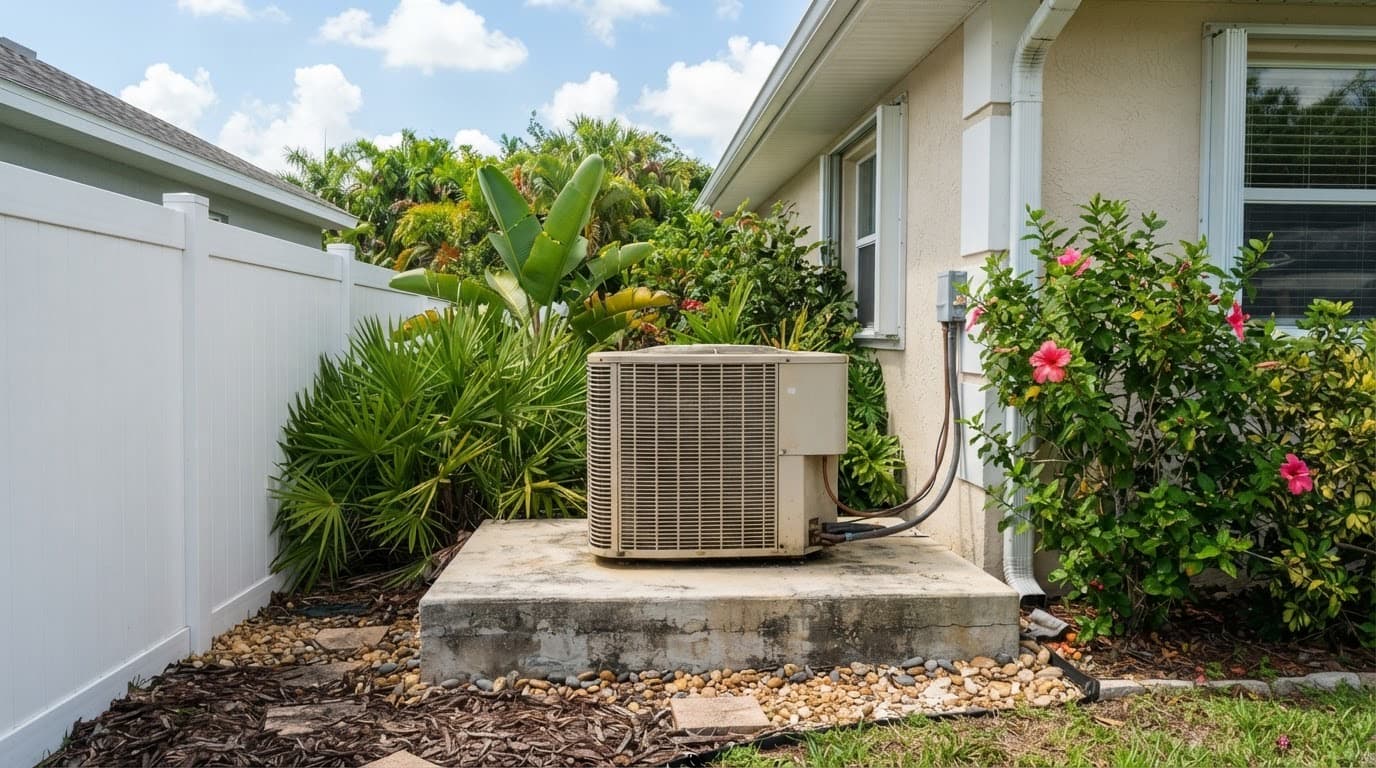
None of this means a coastal Pinellas County home is stuck replacing its HVAC system every few years. Corrosion can be slowed dramatically with the right combination of equipment choices, placement, and maintenance habits, but it does take a more deliberate approach than a system installed 20 miles inland.
The habits that make the biggest difference
Rinsing the outdoor unit with fresh water on a regular basis is one of the simplest and most effective habits a homeowner can build. It physically washes the accumulated salt film off the coil before it has time to sit and react with the metal. This only works with the power off and the unit rinsed gently, since high-pressure spray can bend fins or force water into places it should not go.
Homeowners who build this into a monthly routine, rather than an occasional afterthought, see noticeably less coil buildup over a season than those who rely on rainfall alone to do the job.
Placement decisions that reduce exposure over time
Placement matters just as much as maintenance. A few practical adjustments can meaningfully change how much salt exposure a unit takes on over its lifetime:
- Positioning the outdoor unit away from direct, unobstructed wind off the water where the home's layout allows it
- Using landscaping, fencing, or the structure of the home itself as a partial wind break
- Elevating the unit where flooding or storm surge is also a risk, which has the side benefit of reducing salt spray contact
None of these placement choices eliminate exposure entirely, but together they can meaningfully extend the window before corrosion becomes a serious problem.
Equipment and service choices worth the investment
Beyond placement, there are equipment and service choices that make a real difference over the life of the system:
- Coastal-rated or coated coil options, which resist salt penetration better than standard finned coils
- Protective coatings applied to exposed metal components during installation or as part of routine service
- A spring maintenance visit timed before peak cooling season, since corrosion is progressive and easier to manage early than to reverse later
A matched-technician visit that includes a close inspection of the coil, the electrical connections, and the refrigerant lines catches corrosion while it is still a maintenance issue rather than a replacement decision. That is a large part of why FL HVAC Team treats coastal maintenance schedules differently across its Pinellas service area than it does further inland.
Conclusion
Saltwater corrosion is not a rare or unlucky problem in Pinellas County. It is a predictable, physics-driven process that affects nearly every outdoor HVAC unit within reach of Gulf and bay winds, and it moves faster than most homeowners expect. The good news is that once you understand how it works, there is a lot you and a good technician can do to slow it down.
The homes that get the most life out of their systems near the coast are almost never the ones with the newest equipment. They are the ones whose owners caught the early signs, kept up with rinsing and inspections, and worked with a technician who actually understood what salt exposure does differently in this part of Florida. A system that gets that kind of attention from day one can perform reliably for years longer than one that does not.
If your outdoor unit shows any of the signs described here, or if you simply want a coastal-specific maintenance plan built around where you actually live, it is worth having someone take a real look before a small issue becomes a major repair. Corrosion rarely reverses itself, but it almost always responds to attention caught early.
Dealing with a unit that seems to be struggling more than it should near the coast? FL HVAC Team matches you with a technician who understands what saltwater exposure actually does to a system in this part of Florida, and can walk you through what your unit needs to hold up for the long run.